
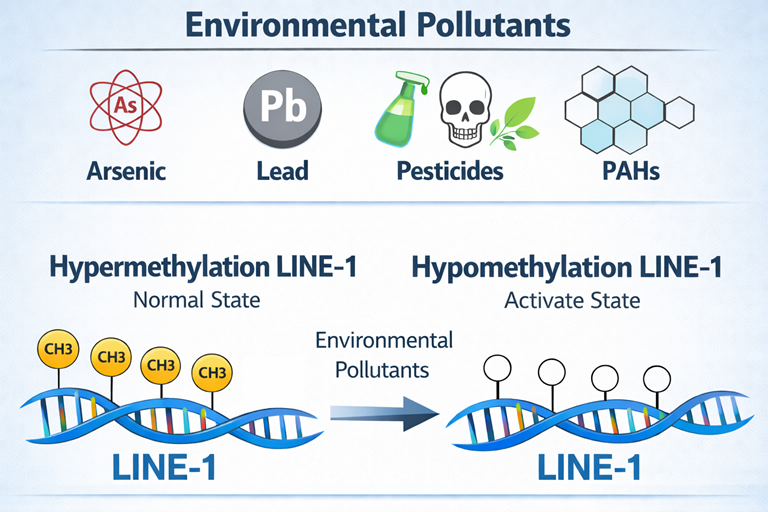
LINE-1 (long interspersed nuclear element-1) is a class of transposable elements widely distributed in the human genome, accounting for approximately 17% of the genome. Under normal physiological conditions, LINE-1 sequences are typically maintained in a highly methylated state (hypermethylation), which suppresses their transposition activity and helps preserve genomic stability. When LINE-1 becomes hypomethylated, its transpositional activity may increase, potentially leading to insertion mutations, chromosomal instability, or abnormal gene expression. Numerous studies have demonstrated that LINE-1 demethylation is associated with increased risks of various diseases, including cancer, cardiovascular diseases, and metabolic disorders. In addition, environmentally induced changes in LINE-1 methylation status are believed to contribute to multiple pathological mechanisms, such as abnormal cellular proliferation, increased oxidative stress, and genomic instability. In epidemiological studies, LINE-1 methylation levels are frequently used as a surrogate marker of global DNA methylation because LINE-1 sequences are widely distributed throughout the genome and can reflect the overall methylation status of genomic DNA. Therefore, alterations in LINE-1 methylation not only reflect changes in epigenetic regulation but may also serve as an important molecular link between environmental exposure and disease risk.
In modern industrial environments, many environmental pollutants and occupational exposure factors have been shown to influence the epigenetic regulation of DNA. Among them, arsenic, lead, pesticides, and polycyclic aromatic hydrocarbons (PAHs) are the most extensively studied contaminants. Epidemiological studies have shown that populations chronically exposed to arsenic-contaminated water or occupational arsenic exposure exhibit significantly reduced LINE-1 methylation levels in blood DNA, suggesting that arsenic exposure may induce LINE-1 demethylation. Previous studies have proposed that arsenic may alter DNA methylation through mechanisms involving oxidative stress or disruption of the one-carbon metabolism pathway, thereby affecting methylation reactions and ultimately altering genome-wide DNA methylation patterns, including those of LINE-1. In addition, occupational exposure to lead has also been reported to reduce methylation levels in the LINE-1 promoter region. Studies involving battery factory workers and cellular models have demonstrated a negative correlation between blood lead levels and LINE-1 methylation. Research on pesticide applicators has further revealed that individuals with long-term pesticide exposure exhibit significantly lower LINE-1 methylation levels compared with unexposed populations, suggesting that pesticides may alter genomic stability through interference with epigenetic regulation. Furthermore, air pollutants such as PAHs have also been reported to modify LINE-1 methylation patterns, indicating that exposure to air pollution may influence human epigenetic states, particularly during early developmental stages. Therefore, various environmental pollutants and occupational exposure factors may alter LINE-1 methylation through epigenetic mechanisms and may serve as important molecular indicators for assessing the biological effects of environmental exposure.
To evaluate LINE-1 methylation levels, researchers commonly employ several DNA methylation analysis techniques. First, genomic DNA is typically subjected to bisulfite conversion, in which unmethylated cytosines are converted into uracil while methylated cytosines remain unchanged, allowing differentiation between methylated and unmethylated sequences. After bisulfite treatment, pyrosequencing can be used to quantitatively analyze the methylation percentage at CpG sites within LINE-1, and this approach is widely applied in environmental epidemiology studies. Another commonly used method is quantitative methylation-specific PCR (qMSP), in which researchers use methylation-specific primers and probes to detect the methylation status of the LINE-1 promoter region and compare differences among exposure groups. In large-scale studies, next-generation sequencing (NGS) or whole genome bisulfite sequencing (WGBS) can also be employed to evaluate methylation changes in LINE-1 as well as other genomic regions. These approaches can be applied to blood DNA, tissue DNA, or other biological samples, enabling analysis of environmental exposure effects on epigenetic regulation at the molecular level. By integrating molecular biology techniques with genomic analysis methods, researchers can accurately measure changes in LINE-1 methylation and explore their associations with disease development and environmental exposures.
The detection of LINE-1 methylation levels has significant value in public health and biomedical research because alterations in LINE-1 methylation can serve as biomarkers for assessing the effects of environmental pollution and occupational exposure. For example, in studies of lead exposure, LINE-1 methylation levels have been shown to be significantly negatively correlated with blood lead concentrations, suggesting that this epigenetic marker may be used to evaluate exposure levels and potential toxic risks. In arsenic exposure studies, LINE-1 demethylation has also been associated with health conditions such as hypertension, indicating that this epigenetic marker may reflect the long-term health impacts of environmental pollution. By establishing reliable LINE-1 methylation detection methods, researchers may monitor molecular changes induced by environmental exposures before disease onset, thereby enabling early warning and health risk assessment. Furthermore, in the fields of occupational health management and environmental monitoring, LINE-1 methylation analysis may also be used to evaluate exposure risks among different occupational populations and to develop appropriate protective strategies. With the advancement of high-throughput epigenomic technologies, LINE-1 methylation analysis is expected to become an important tool in environmental toxicology and precision medicine, helping researchers better understand how environmental pollutants influence human health through epigenetic mechanisms.
Reference:
- Hossain, K., Suzuki, T., Hasibuzzaman, M. M., Islam, M. S., Rahman, A., Paul, S. K., Tanu, T., Hossain, S., Saud, Z. A., Rahman, M., Nikkon, F., Miyataka, H., Himeno, S., & Nohara, K. (2017). Chronic exposure to arsenic, LINE-1 hypomethylation, and blood pressure: a cross-sectional study in Bangladesh. Environmental health : a global access science source, 16(1), 20.
- Sokolowska, K. E., Antoniewski, J., Sobalska-Kwapis, M., Strapagiel, D., Marciniak, W., Lubiński, J., & Wojdacz, T. K. (2025). Synergic effect of arsenic exposure related methylation changes in three cohorts exposed to levels of this toxicant. International archives of occupational and environmental health, 98(6), 515–523.
- Li, C., Yang, X., Xu, M., Zhang, J., & Sun, N. (2013). Epigenetic marker (LINE-1 promoter) methylation level was associated with occupational lead exposure. Clinical toxicology (Philadelphia, Pa.), 51(4), 225–229.
- Benitez-Trinidad, A. B., Medina-Díaz, I. M., Bernal-Hernández, Y. Y., Barrón-Vivanco, B. S., González-Arias, C. A., Herrera-Moreno, J. F., Alvarado-Cruz, I., Quintanilla-Vega, B., & Rojas-García, A. E. (2018). Relationship between LINE-1 methylation pattern and pesticide exposure in urban sprayers. Food and chemical toxicology : an international journal published for the British Industrial Biological Research Association, 113, 125–133.
- Lee, J., Kalia, V., Perera, F., Herbstman, J., Li, T., Nie, J., Qu, L. R., Yu, J., & Tang, D. (2017). Prenatal airborne polycyclic aromatic hydrocarbon exposure, LINE1 methylation and child development in a Chinese cohort. Environment international, 99, 315–320.
- Issah, I., Arko-Mensah, J., Rozek, L. S., Zarins, K. R., Agyekum, T. P., Dwomoh, D., Basu, N., Batterman, S., Robins, T. G., & Fobil, J. N. (2021). Global DNA (LINE-1) methylation is associated with lead exposure and certain job tasks performed by electronic waste workers. International archives of occupational and environmental health, 94(8), 1931–1944.
04/15/2026 updated.